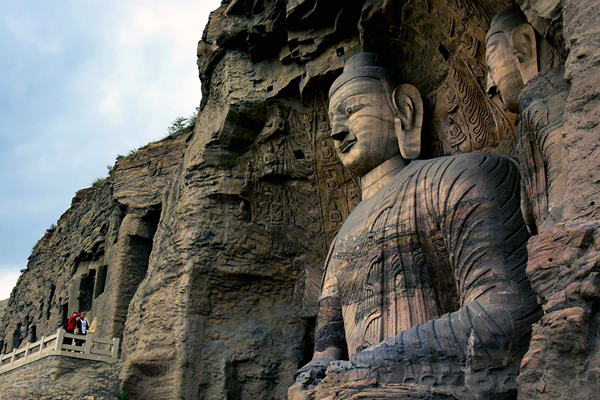
Yungang Grottoes
Introduction
The Yungang Grottoes, located at the southern foot of Wuzhou Mountain, approximately 16 kilometers west of Datong in Shanxi province, China, are a remarkable testament to the artistic and cultural achievements of ancient China. Constructed against the mountain, these grottoes stretch over a kilometer from east to west and encapsulate an astounding 45 caves, 252 Buddhist shrines and 59,000 statues within an 18,000 square meter area. This magnificent site stands as a paramount example of Buddhist cave art executed during the 5th and 6th centuries, during the Northern Wei Dynasty (386-534). The Yungang Grottoes were inscribed as a UNESCO World Cultural Heritage site in 2001, acknowledging their exceptional historical and cultural importance.
The grottoes are not only an outstanding achievement in the realm of art but also a profound expression of the cultural synthesis between ancient China and other civilizations. While influenced by the Buddhist cave art of South and Central Asia, the Yungang Grottoes manifest a distinctive Chinese character and local spirit. This unique blend of external and indigenous elements has positioned the Yungang Grottoes as an essential milestone in the history of Oriental Buddhist grottoes, significantly impacting the development of Buddhist cave art in China and the broader East Asian region.
Historical Background
The creation of the Yungang Grottoes is intricately tied to the historical milieu of the Northern Wei Dynasty. During 398 to 494, the dynasty established its capital at Pingcheng, present-day Datong city, which set the stage for a flourishing of cultural exchanges and artistic development. This dynamic era provided the foundation for the formation of Yungang Grottoes art under the leadership of the rulers of the Northern Wei Dynasty. The grottoes were conceived as a means to unite China's war-torn ethnic groups under the unifying banner of Buddhism, reflecting the dynasty's broader sociopolitical objectives.
The construction of these grottoes began in 460 under the supervision of the monk Tan Yao, who was tasked with overseeing the project. The first phase, known as the Five Grottoes of Tan Yao, is renowned for its grandeur and scale, representing the initial peak of Chinese Buddhist art. As the Northern Wei moved its capital from Datong to Luoyang in 494, the continuation of the grottoes' construction was taken up by affluent local families in Datong, while the royal family initiated the Longmen Grottoes in Luoyang. This transition underscores the Yungang Grottoes' pivotal role in marking the spread of Buddhism into central China.
Cultural Significance
The cultural significance of the Yungang Grottoes is multifaceted, encompassing religious, artistic, and historical dimensions. As one of China's four great ancient grotto complexes, alongside the Mogao, Maijishan, and Longmen Grottoes, Yungang holds an eminent place in the annals of Chinese history. The grottoes signify the beginning of Buddhism's proliferation into central China, serving as a vital conduit for the religious and cultural exchanges between China and neighboring regions.
The Yungang Grottoes are a treasure trove of grotto art that harmoniously integrates traditional Chinese art forms with foreign influences, particularly Greek and Indian elements. This cultural amalgamation is evident in the diverse array of sculptures and architectural styles present within the grottoes. Moreover, the grottoes serve as a profound reflection of China's historical interactions and exchanges among various ethnic groups, illustrating the dynamic cultural milieu of the time.
Architecture and Art
Architecturally, the Yungang Grottoes showcase an extraordinary diversity and complexity, with distinct phases of construction reflecting the evolving artistic styles and influences over time. The grottoes are divided into three primary sections: the early rock caves, the middle oblong-shaped caves, and the square grottoes with pagoda-shaped central columns. The early rock caves, primarily oval-shaped and large, feature statues reaching as tall as 17 meters. The middle section comprises oblong-shaped caves in two chambers, adorned with intricate Buddhist relief sculptures on their walls, arches, and roofs. The square grottoes stand out with their sculpted pagoda-shaped central columns, demonstrating exceptional craftsmanship.
Among the notable caves is Cave 5, which houses a seated Buddha statue standing 17 meters tall. Cave 6 features a two-storied pagoda pillar and depicts the life of the Buddha from birth to Nirvana. Each grotto offers a unique glimpse into the religious and cultural narratives of the time, with varying depictions of deities, musical instruments, and symbolic motifs.
Preservation and Modern Conservation Efforts
The preservation and conservation of the Yungang Grottoes have been a focus of sustained effort, ensuring that this cultural heritage site endures for future generations to appreciate. Over the centuries, the grottoes have undergone restoration and maintenance, often driven by ethnic groups who valued the site's historical and cultural significance. Modern conservation initiatives have embraced advanced technologies, such as digital scanning and 3D printing, to document and preserve the intricate details of the grottoes' sculptures and architectural features.
Significant strides have been made in digital documentation, aiming for completion by 2030. Collaborative efforts with institutions such as Peking University and international partners have expanded research and conservation initiatives, broadening the influence of Yungang Studies globally. The integration of digital technologies, alongside meticulous restoration practices, exemplifies the ongoing commitment to preserving the Yungang Grottoes' legacy as a beacon of historical, artistic, and cultural excellence.








